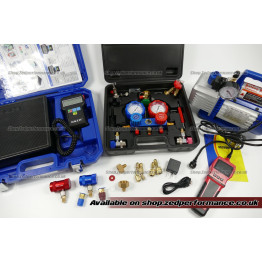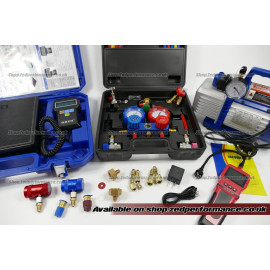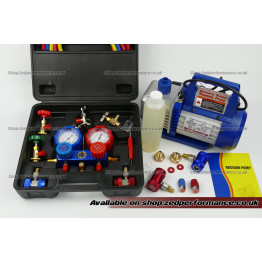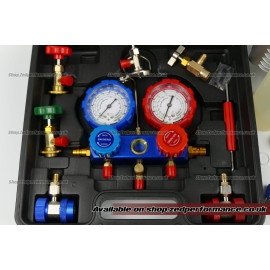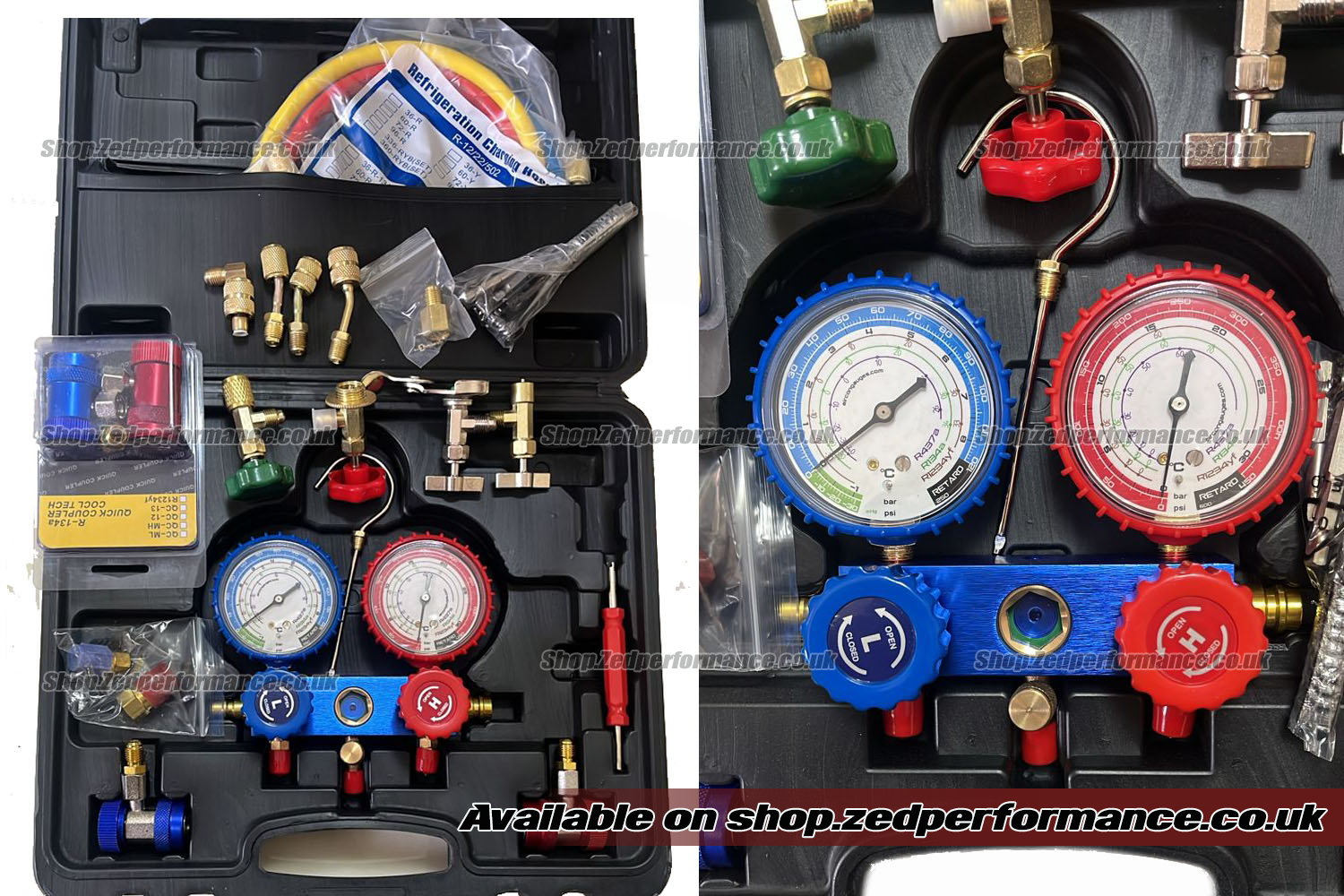
Auto AC Gauges for R437a R1234yf R134a
| Brand: | Aircon Tools |
| Product Code: | auto-ac-gauges |
-
£99.99 VAT incl.
Available Options
Automotive AC Manifold Gauge Set
This car AC gauge set is designed for checking air conditioning pressures and connecting equipment for refrigerant charging, recovery and evacuation. It includes fittings for R134a and R1234yf vehicle systems plus an R12 adaptor.
The manifold set is suitable for A2L and A3 refrigerants. A vacuum pump and recovery unit are available as optional additions. They carry out different jobs and are not included in the base gauge set.
Refrigerant Gauge Scales
- R134a: used in many vehicle air conditioning systems.
- R437A: used in some classic car systems converted from R12 where the conversion specification allows it.
- R1234yf: used in many newer vehicles.
Always check the refrigerant label on the vehicle. A fitting adaptor does not make different refrigerants interchangeable.
Included Fittings and Adaptors
- R134a quick couplings.
- R12 adaptor.
- R1234yf quick couplings.
- Four types of refrigerant canister opening tap valve.
- Medium-size flammable refrigerant bottle connector with a 1/4-inch male adaptor.
What Do A2L and A3 Mean?
A2L and A3 describe refrigerant safety classes. The letter A means lower toxicity. A2L refrigerants are mildly flammable and have a low burning speed. R1234yf and R32 are common examples. A3 refrigerants are highly flammable. Examples include R290 propane and R600a isobutane.
For systems using flammable refrigerants choose a vacuum pump and recovery unit specifically approved for the refrigerant involved. Approval for A2L alone does not establish suitability for A3. The gauge scales listed above do not provide R32, R290 or R600a temperature scales.
Why Add a Vacuum Pump?
A refrigerant vacuum pump removes air and helps remove moisture from an empty AC system before charging. It is used after repairs that open the system or when preparing an empty system for a recharge. Air and moisture left inside can affect cooling and cause problems within the system.
A vacuum pump does not recover refrigerant. Any remaining refrigerant must first be removed using suitable recovery equipment.
Benefits of Our Pump's Solenoid and Vacuum Gauge
Our optional A2L and A3 vacuum pump is fitted with a solenoid valve and a vacuum gauge.
- Solenoid valve: closes the inlet when power is removed. This helps protect the vacuum already created and prevents pump oil being drawn back towards the AC system if the pump stops or power fails.
- Built-in vacuum gauge: provides a convenient indication of vacuum at the pump while it is running. It makes basic monitoring easier than using a pump with no gauge.
Compared with a simple pump without these features you gain automatic inlet protection and an easy vacuum check. They do not by themselves make the pump faster or produce a deeper vacuum.
For accurate deep-vacuum measurement and a vacuum hold test use a separate micron gauge at the system and isolate the pump as directed in its instructions. A basic pump gauge cannot confirm that all moisture has been removed or that the system is leak-free.
Why Add a Refrigerant Recovery Unit?
A recovery unit transfers refrigerant from the AC system into a suitable recovery cylinder. You need it when removing an existing charge before repairs or replacing the refrigerant. A recovery cylinder is required separately unless specifically included.
Recovery and recycling are different processes. A recovery-only unit does not automatically clean the refrigerant or confirm that it is suitable for reuse.
Optional Equipment
- 100kg refrigerant scales: measure the amount of refrigerant charged or recovered. Charge to the vehicle's specified weight rather than judging by gauge pressure alone.
- Large BOC bottle adaptor.
- Large A2L and A3 BOC bottle adaptor.
- A2L and A3 vacuum pump with solenoid valve and vacuum gauge.
- A2L and A3 refrigerant recovery unit.
Select the extras you need above the Add to Cart button. Check bottle connections and equipment compatibility before ordering. Flammable refrigerant work requires suitable training and the equipment manufacturer's handling procedures.